

This is a huge topic to fit in 1 blog but I’m going to give it a go. Based upon our experiences with anxiety, meltdowns and autism with Iris but I hear from speaking with others on the spectrum it will apply to many so hopefully sharing will help.
Managing Anxiety & Meltdowns on the Spectrum
It isn’t that being autistic means straight away Iris has anxiety or a behavioural disorder, but it can be a by-product of her complex set of processing differences. We can lower anxiety by understanding the causes behind it.
It is not possible to separate the autistic processing differences from Iris.
You cannot ‘cure’ her from this. It is how she functions, how her brain is wired in its own unique way. It can be overly active, acutely sensitive and have underdeveloped pathways to different areas but also overdeveloped scattered connections too. I’m not sure I will ever know exactly why but I do know there is an effective and productive way forwards. We can aid and support, live a happier healthier life.
We can reduce anxiety therefore lowering the likelihood of meltdowns & shutdowns.
I regularly assess Iris’s unique ways of perceiving and processing the world and create plans to support her through her sensory, cognitive, social, and emotional struggles.
What can cause a Meltdown/Shutdown?
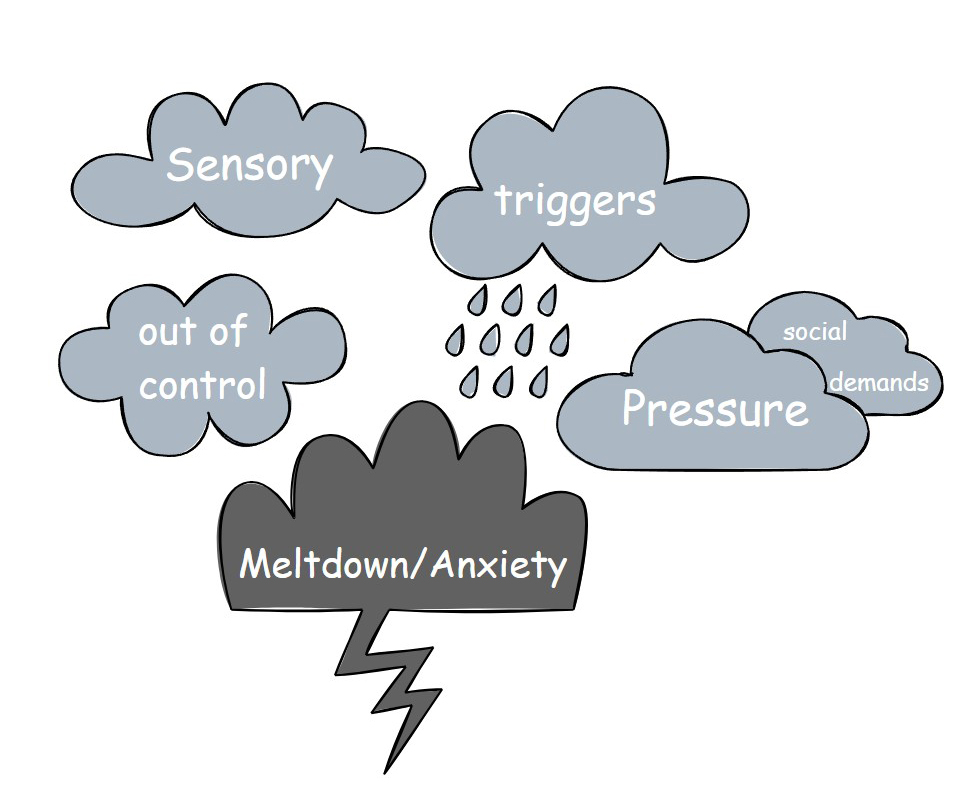
Try to imagine a meltdown or shutdown like the lightning in the storm, before this happens there is a build-up, clouds gather, there is a change in the air. Many components come together to create a storm and this is the same with a Meltdown or shutdown.
It is hardly ever one trigger, more like an ever changing, morphing set of moving clouds. We need to look at the whole picture and all of the elements – triggers. These can also be amplified when you factor in insomnia or communication difficulties. A meltdown is when the bodies stress chemicals have got to extreme levels, the “fight or flight” reaction sets in. A lightning bolt – immediate release of these chemicals. A shutdown on the other hand is like the opposite, it’s a protective mode to manage the stress chemicals getting too high. Both are signs of extreme distress and should never be looked upon as a tantrum or to be ashamed of.
What can we do to help with anxiety and Meltdowns
A few examples:
Sensory Issues
Too noisy – ear defenders or ear plugs, move to a quiet area, turn lights and electronics off
Sensitivity to light – turns lights off, sunglasses on outside or in the car.
Feelings within the body – deep pressure, massage can disperse the stress chemical build up
Smells from cooking – open windows
Cluttered space – tidy up, keep things in order and clean space
Too hot/cold – help change clothing, open windows…adjust temp
Uncomfortable clothing – try using soft cotton clothing, no labels, good fit
Out of control
Not knowing what is happening next or how long an activity will go on for – make a clear plan, break down into small stages
Try adding in more closed loop activities with a clear start and finish in one session.
Being told what to do – give choices
Needing independence – teach life skills in manageable stages
Stressed in new situations – prepare before with social stories, looking at websites, google maps…
Changes of plan – give a clear new plan to refer to
Social Demands
Social Demands and Pressure – Give time and more time. Socialising is exhausting for someone who is autistic. Reduce pressure where possible.
Triggers – observe what is triggering them and try to reduce those parts or help them manage the triggers so that it will help settle the clouds brewing.

For every person on the spectrum what helps them through their anxiety and what calms the storm in a meltdown will be different. I’m afraid its very often a case of trial and error to work it out. Start with observing what naturally works, what are they drawn to as they calm down. Create a ‘Happy Basket’ of sensory items and things that help them and you through the tough times or in the recovery stage after a meltdown. Iris’s basket includes sensory putty, a song book journal with the lyrics of all of her favourite songs, fabric that feels like Luna her rabbit, perfumed moisteriser, song list from Spotify, photo journal of activities and outings we have done. They are all items to calm, to transport Iris into a different frame of mind.
Work out if they need more clarity in the plan for the day. Maybe tasks need to be broken down into bit size chunks. Sometimes a set protocol that works when they are feeling things going in the wrong direction can help. Create an emotional support plan that you can all work from.
Environment
At times the environment needs to change, the simple act of moving Iris into another space can shift and change the mood & emotions. One of the hardest challenges I have found is realising when the environment is literally human, it’s us, it’s me. How to handle that when it’s the people around you too, your family. Our words, our body language, our speech. Without realising it we are within the clouds gathering adding to the storm.

How we can make conversations easier

So this whizz stop tour comes to and end but I hope it’s the beginning of a journey to finding solutions that make life a little easier.
For more information please have a read of our e-booklet on The Little Explorers Activity Club website.
Please share in the comments any advice, thoughts and experiences you have had with this as a person on the spectrum or a parent, carer 😊
 Iris Grace Painting
Please read this:
CEASE THERAPY – Healing Children with Autism with homeopathy to clear the toxic substances.
by Dr. Tinus Smits http://www.cease-therapy.com
They have over 500 CEASE practitioners around the world.
http://www.cease-therapy.com/make-appointment
Hi Arabella, I’m a AudHDer, a longtime follower of your family’s journey, and co-traveler with also navigating neuro-affirming co-regulation family and therapy practices. I have found learning somatic experiencing techniques and therapies, along with setting in place strong boundaries and accommodations for myself with social settings and home life, to be the most beneficial for lessening the frequency and severity of my meltdowns, and especially shutdowns. I find daily breathing exercises helpful in lots of ways related to muscle clenching/tension and anxiety, and walks or weight lifting great ways to ground myself, focusing on where I am in the moment and releasing energy in good ways to combat overwhelm and fatigue. Hope these suggestions are are beneficial, and please let me know if there’s anything else I can do to be helpful ❤️
that’s really helpful thankyou 🙂 yes we find breathing exercises help and actually lately singing too. We went to a spring equinox eve celebration and it was all about singing, being free, using your voice and Iris loved it. She slept so well after that.
Outstanding guidance!
Thankyou Vicki x
So glad to see you back to blogging! Always enjoy your lovely advice and words of wisdom.
thanks xx
Thank you. I found that really useful as a teacher, parent of an autistic child and recently diagnosed myself. I love the idea of a journal of activities and visits that someone can look through to help them to reset.
Its a pleasure, well out of all the things I have tried the journal idea is the most powerful and the song lyrics. Iris doesn’t like to write so I print out pics just on computer paper and we stick them in this special book she has. I then write down the dates and any notes she wants. It also works the other way so it can be for future events too. Iris was getting very OCD about the calendar at the beginning of the yr and wanted to know when everything was going to be so to switch the interest around into not so panicky we started to work on the activity journal. It worked very well and she loves it. Its like a planner and memory book in one. Plus helps anxiety on the future events too.